60 Seconds with Noemí Malgrat González: Scaling AI and Personalising Engagement in Pharma
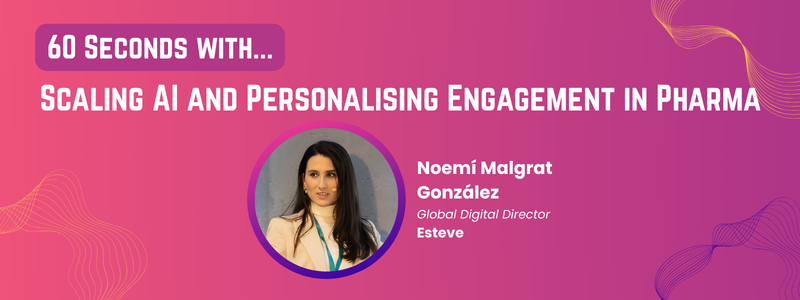
1. Future Pharma EU is bringing together commercial, marketing and sales leaders from across Europe. What are you most looking forward to about joining the discussions in Amsterdam?
The most useful conversations are the practical ones — less about where AI and digital could go, and more about what is actually working, and not working, in our day-to-day reality. I am looking forward to sharing both the excitement and the challenges with peers. The playbook for scaling digital engagement looks genuinely different depending on your size, structure and maturity. Smaller, focused companies often have advantages that go unspoken. Amsterdam is a valuable opportunity to test that thinking with people solving similar problems from very different starting points.
2. Your session focuses on moving beyond AI pilots to enterprise-wide adoption. What do you think is the biggest barrier preventing pharma organisations from scaling AI successfully today?
The barrier is rarely the technology. It is ownership and operating model: who makes the decisions, who funds the work, and who is accountable for scaling it. Pilots stay pilots when governance becomes too complex, business cases take too long, and teams are not encouraged to experiment. AI also struggles when digital is still treated as a support function rather than a commercial capability. The organisations moving fastest prove value through focused pilots, reinvest the efficiency gains, and build adoption step by step. That creates a self-funding ladder rather than an open-ended bet.
3. You'll also be hosting a discussion on engagement strategies for rare disease. How does personalisation differ when every HCP interaction counts, and what lessons can larger organisations learn from rare disease engagement?
In rare disease, personalisation is not about creating more versions of an email. It is about bringing together as many relevant data points as possible — from digital behaviour, CRM data and field-team insights — to understand where each HCP is in their journey. From there, the key question is when the field should engage and accompany, and where digital can support before, between and after those interactions. The lesson for larger organisations is simple: effective personalisation is not more contact. It is greater precision, stronger coordination and continuity across every interaction.
4. If attendees could leave your session with one practical idea they can implement immediately, what would you want it to be?
My practical idea would be: stop waiting for perfect conditions. We often wait for perfect data, perfect governance or the perfect platform, and that slows everything down. Choose one real problem, give a small team the space to test a solution, and focus on whether it makes something genuinely better — faster for teams, more relevant for HCPs or more useful for patients. Learn from it, improve it and then expand. Progress rarely starts with everything being ready; it starts with the courage to begin.